Churn & Offboarding
Prism Customer Success Handbook — Section 3.8 · Type: Lifecycle
⚠️ Partially built. The CSP has a Mark-as-Churned workflow (sets account status, writes an event-backed activity), but no Lifecycle playbook wraps it. This page defines the target process; scoped in
BUILD_BACKLOG.mdfor the v2 push.
Trigger
Fires when forecast category is set to Will Not Renew, or when notice is received directly.
Will Not Renew requires a customer signal, not a hunch (2.6 Renewal Forecasting) — notice given, or a definitive statement from someone with authority. A strong feeling that an account will churn is At Risk, and belongs in 3.2 Renewal Risk where it still gets worked. Opening this playbook early is self-fulfilling: write the account off, stop investing, watch the prediction come true.
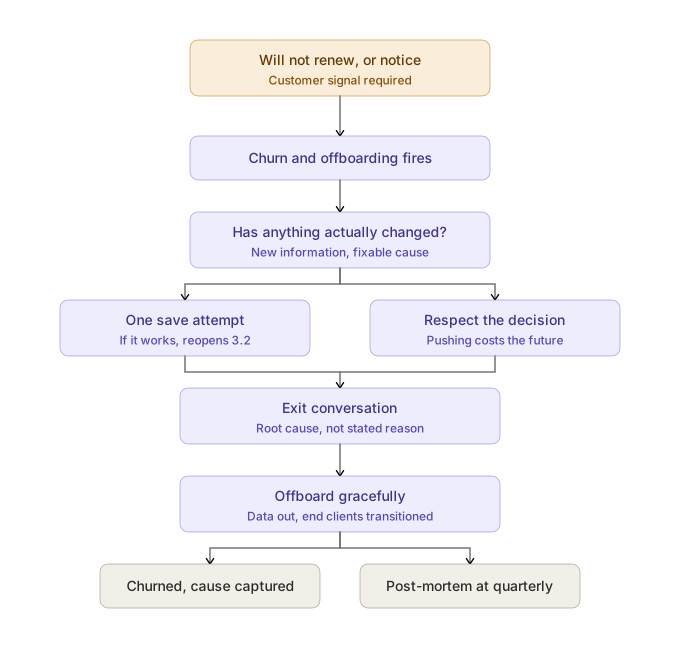
The framing that matters
Churn is a process, not an instant. There is a window between "they told us" and "the contract ends," and that window contains the most valuable work in the whole playbook — because it's the only time the customer will tell you the truth.
Before the decision, they're negotiating. After it, they have nothing to lose by being honest. The exit conversation is the single best source of information CS ever gets, and most functions waste it by treating churn as an administrative event.
Objective
Understand why this actually happened, exit the customer cleanly, and leave the door open.
Owner
CSM. Director of CS for Enterprise churn and exec-to-exec exit conversations (2.5 Cross-Functional Interfaces).
Entry criteria
- Will Not Renew set, or notice received, and
- No Churn & Offboarding playbook already active
Procedure
1. Decide whether a save attempt is warranted
This is not Renewal Risk. By the time this playbook opens, the customer has decided and said so. A save attempt here is legitimate in exactly one circumstance: something has genuinely changed — new information, a cause that's now fixable, a decision made on a misunderstanding.
If nothing has changed, respect the decision. Continuing to push someone who has already decided costs more than it can win:
- It converts a neutral ending into a bad one
- It burns the relationship with a champion who may resurface at another company
- It reads as not listening — which, if the churn was caused by not listening, confirms their decision
One attempt, on new grounds, or none. If the attempt succeeds, close this playbook and reopen 3.2 Renewal Risk — the renewal is live again and should be worked as such.
2. Run the exit conversation
The most valuable half hour in the playbook. Ask for it explicitly and frame it honestly: we're not trying to change your mind, we want to understand what happened.
Get to root cause, not stated reason. "Price" is almost never the actual cause — it's the socially acceptable way to describe a value failure. The useful question is not why are you leaving but when did you first start thinking about it, and what was happening then?
| Root cause | What it usually looks like |
|---|---|
| Never reached value | Stalled in onboarding — often at milestone 3 — and never recovered. The account was lost months ago; the renewal date just made it official. |
| Lost champion | The person who chose Prism left, the successor had no attachment, nobody rebuilt the case (3.4 Champion Departure). |
| Product gap | A capability they genuinely needed and we don't have. Routes to Product (2.8 Voice of Customer & Product Feedback). |
| Service failure | Escalations handled badly, slow resolution, feeling unheard. |
| Their business changed | They lost the clients the reports served, restructured, or were acquired. Not preventable — and worth recording as such. |
| Price / value mismatch | Almost always a value failure in disguise. Probe: would they have paid it if the value had been clear? |
Distinguish "we lost them" from "they left." Some churn isn't preventable, and a function that treats every loss as a failure learns nothing from the ones that were. Both get recorded; only the first generates a process change.
SMB churn is often silent — the account simply doesn't renew, with no conversation. That's the common case, not an anomaly. Send a short, genuinely low-pressure email asking for the reason. Response rates are low; the ones you get are disproportionately useful, because someone who bothers to reply has something specific to say.
3. Offboard gracefully — including their end clients
This product has an offboarding problem most SaaS doesn't: the customer's own clients are on the portal.
When a Prism account churns, their end clients lose access to dashboards they've been using for months — and those clients have no relationship with us and no idea we exist. If the portal goes dark without warning, our departing customer takes an avoidable hit with their clients, on the way out.
That matters commercially, not just morally: the person managing that fallout is the person who might recommend or re-buy Prism at their next company.
So:
- Agree a shutoff date explicitly, with enough runway for them to transition their clients
- Ask directly what their clients need — a final report, an export, notice
- Export their data — dashboards, report history, configurations. Withholding is bad practice and usually contractually wrong.
- Confirm what happens to scheduled sends so nothing fires after the relationship ends, and nothing stops without warning
4. Leave the door open
Say plainly that they're welcome back, and mean it. Then:
- Keep the champion's contact details. People change companies. A champion who left on good terms is a warm lead at their next employer — boomerang accounts are real and cheap.
- If the cause was a product gap being addressed, ask whether they'd like to know when it ships. That's a real reason to reconnect rather than a pretext.
The cost of a graceful exit is a few hours. The option value is a future account.
5. Close the loop internally
- Sales is notified, always, with the root cause (2.5 Cross-Functional Interfaces)
- Product gets product-gap causes with full context (2.8 Voice of Customer & Product Feedback)
- Mark the account churned in the CSP — sets status, writes the event-backed activity
- Log the root cause and its category for the quarterly churn review (2.3 Operating Rhythm, 4.5 Churn Review Template)
Segment differences
| SMB | Mid-Market | Enterprise | |
|---|---|---|---|
| Exit conversation | Email ask; often no response | Call, usually granted | Dedicated call, Director of CS attends |
| Save attempt | Rarely warranted | If something changed | Director-level if the ARR justifies it |
| End-client transition | Usually few clients, short runway | Plan it | Can be dozens of client workspaces — start early |
| Post-mortem | Aggregate at quarterly review | Individual, brief | Individual, full (4.5 Churn Review Template) |
Templates
Full versions in 4.1 Email Template Library.
Exit conversation request
Email template
Subject: Would you be open to 20 minutes before we wrap up?
Hi [name] — I'm sorry to see this end, and I want to be clear I'm not asking for a chance to change your mind.
What would be genuinely useful is understanding what happened from your side — what we missed, and when it started going wrong. That helps me do better for other firms in your position.
Any time in the next couple of weeks that works?
SMB silent churn
Email template
Subject: One question, if you have a minute
Hi [name] — I see your subscription is ending on [date]. No sales pitch here, and nothing needed from you.
If you have a spare minute, I'd value knowing what didn't work. One line is plenty.
Offboarding logistics
Email template
Subject: Wrapping up — your data and your clients' access
Hi [name] — a few practical things so nothing catches you or your clients out.
Your portal access ends [date]. Before then I'll get you an export of your dashboards and report history. The main thing worth planning: [N] of your clients currently log in to view reports, so it's worth deciding what they should get in the last cycle and whether you want to tell them anything.
Let me know what would help and I'll set it up.
Escalation path
Escalate (2.7 Escalation Management) when:
- The account is Enterprise — Director of CS is involved in exit conversation and offboarding by default
- The churn involves a dispute — contested terms, a refund request, a service-failure claim
- Data export is contested or complicated, or their end-client transition can't be completed before shutoff
- The root cause is a systemic product or service failure likely affecting other accounts — that's not one churn, it's a pattern with a lead indicator
Exit criteria
Close when all of:
- Contract has ended and the account is marked churned
- Root cause captured and categorized — or a recorded, honest "no response, cause unknown"
- Data exported and delivered
- End-client transition handled — shutoff date agreed, nothing goes dark unannounced
- Internal loop closed — Sales notified, Product informed if relevant, post-mortem scheduled or complete (4.5 Churn Review Template)
What does not count as resolution
- "Churned. Reason: price." A stated reason recorded without probing is a data point that will mislead the quarterly review. Price is a symptom nearly every time.
- The contract lapsed and nobody spoke to them. For SMB this is common but it's still an incomplete playbook — the email ask is the minimum.
- The portal went dark on their clients without warning. A preventable, self-inflicted injury on a departing customer, and the last thing they'll remember about us.
- The post-mortem never happened. The entire value of churn is what it teaches. An uncategorized churn is a loss twice.
Related pages
- 1.4 Customer Lifecycle — Churned as the terminal state
- 1.5 Customer Journey Map — the failure patterns that appear as root causes here
- 2.3 Operating Rhythm — the quarterly churn and loss review
- 2.5 Cross-Functional Interfaces — notifying Sales, Director involvement
- 2.6 Renewal Forecasting — why Will Not Renew requires a customer signal
- 2.8 Voice of Customer & Product Feedback — routing product-gap causes
- 3.2 Renewal Risk — where a successful save attempt returns the account
- 3.4 Champion Departure — a frequent upstream root cause
- 4.5 Churn Review Template — the post-mortem artifact