Renewal Motion
Prism Customer Success Handbook — Section 3.7 · Type: Lifecycle
⚠️ Not yet built. No Lifecycle-type playbook exists in the CSP. This page defines the target process; scoped in
BUILD_BACKLOG.mdfor the Prism v2 push. Until then, the renewal motion runs off the Renewals view and the weekly checkpoint pass (2.3 Operating Rhythm) rather than as a tracked playbook.
Not to be confused with 3.2 Renewal Risk. This is the routine motion that runs on every renewal. The other is the Risk playbook that fires when a renewal is threatened. Both can be active at once — that's the case needing the most attention.
Trigger
Fires on the first renewal checkpoint being reached, calculated from the account's renewal date and segment.
"T" means the renewal date; the number is days before it. T-60 is sixty days before renewal. The convention is segment-portable — T-60 means the same work regardless of account or calendar month — and it makes the weekly pass mechanical: which accounts crossed a checkpoint this week? rather than tracking calendars individually.
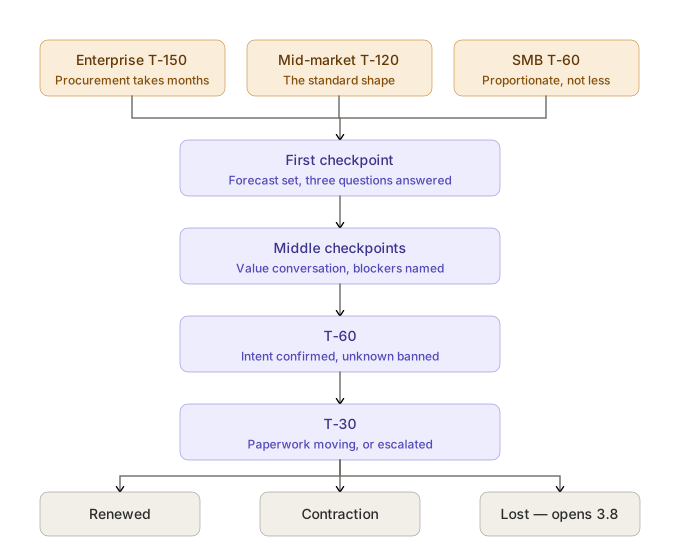
Checkpoints by segment
| Segment | Checkpoints |
|---|---|
| Enterprise | T-150 · T-120 · T-90 · T-60 · T-30 |
| Mid-Market | T-120 · T-90 · T-60 · T-30 |
| SMB | T-60 · T-30 |
Why Enterprise starts at 150. Procurement cycles, security re-reviews, and budget approval routinely take three months on their side. Starting at T-120 means discovering a required security review at T-90 with no time to run it — the renewal then slips past its date for reasons that have nothing to do with satisfaction.
Why SMB compresses to two. A small annual contract with a single decision-maker doesn't need a four-month runway, and a solo CSM running 120-day motions across a large SMB book would spend the entire year on renewals. This is proportionate care, not less care: most SMB renewals are auto-renew with no conversation, and these two checkpoints exist to catch the ones that aren't.
Objective
Reach the renewal date with the decision already made — no surprises in either direction.
Owner
CSM. Sales joins for pricing or contract changes; Director of CS for Enterprise saves and commercial exceptions (2.5 Cross-Functional Interfaces).
Entry criteria
- First segment checkpoint reached, and
- Account is active and not already churned
What each checkpoint requires
Every checkpoint has a required output, not just an activity. "Checked in on the account" is not a checkpoint.
First checkpoint (T-150 Ent / T-120 MM / T-60 SMB)
Output: forecast set with a stated reason, and the three renewal questions answered.
- Who decides? A named economic buyer. If there isn't one, that's the first problem — an Enterprise renewal with no identified budget holder cannot be forecast Commit (2.11 Exception Handling).
- What's the value case? Concrete evidence of what's been delivered. If the value record is thin, this checkpoint is where you find out — with months to fix it rather than weeks.
- What could get in the way? Named blockers, not general unease.
Unknown is an acceptable forecast here. It's early, and the checkpoint's job is to find out.
Middle checkpoints (T-120/T-90 Ent · T-90 MM)
Output: value conversation held with the buyer, and blockers named.
This is where the renewal is actually won or lost. The conversation is about outcomes against their stated objectives — not about the contract. Don't lead with the renewal; an opening line about contract dates tells the customer the call is about our quarter, not their outcome.
For Enterprise, also confirm the process path: is a security re-review required? Does procurement need a vendor reassessment? Who signs, and does that person know it's coming?
T-60
Output: intent confirmed, or risk escalated.
Unknown is banned from this checkpoint onward (2.6 Renewal Forecasting). An Unknown at T-60 is not a forecast — it's an admission the motion never started, and it's a prioritization failure rather than a data gap.
If intent is not confirmed by now, the account moves to P2 in triage (2.4 Account Prioritization Framework) and Renewal Risk (3.2 Renewal Risk) opens if it hasn't already.
T-30
Output: paperwork in motion, or an escalation that explains why not.
By T-30 there should be no open questions about whether — only about when the signature lands. If a value conversation is happening at T-30, the motion failed earlier and this is a rescue, not a renewal.
The principle behind the whole motion
Renewals are earned continuously, not negotiated at the end of the contract.
The checkpoints exist so the value conversation happens with time to change the outcome. If the first renewal conversation is also the first value conversation, the motion has already failed — everything after that is negotiation, and negotiation is where discounts replace value.
The most common failure this playbook prevents is invisible value (1.5 Customer Journey Map, stage 5): the product worked, nobody counted, and the buyer is asked to re-commit budget with no evidence in front of them. That's why the value record starts at onboarding close-out (3.6 New Customer Onboarding) and is maintained continuously (2.3 Operating Rhythm), not assembled at T-60.
Segment differences beyond the checkpoints
| SMB | Mid-Market | Enterprise | |
|---|---|---|---|
| Value conversation | Usually written — a value summary email | Cadence call agenda item | Dedicated conversation, often the EBR (4.3 EBR Kit) |
| Buyer contact | Often the same person as the user | Practice lead | Economic buyer, sometimes with Director of CS |
| Process risk | Minimal — card on file or simple PO | Some procurement | Security re-review, procurement, legal — plan for it |
| Sales involvement | Only if terms change | If terms change | Frequently, plus Director for saves |
Templates
Full versions in 4.1 Email Template Library.
Value summary (SMB, T-60)
Email template
Subject: Your year on Prism — and what's next
Hi [name] — your renewal comes up on [date]. Before then, a quick picture of the year: [N] clients live on the portal, [N] reports delivered on schedule, [specific outcome].
Nothing needed from you unless something's changed on your side — but if you'd like to talk through what next year looks like, I'm happy to find time.
Value conversation request (MM/Enterprise, middle checkpoint)
Email template
Subject: Where [account] is getting value — worth 30 minutes?
Hi [name] — before we get to the contract conversation later this quarter, I'd rather spend the time on whether this is delivering what you hoped when you started.
I've pulled together what we've seen: [specific evidence against their stated objectives]. I'd like to walk through it, hear what isn't landing, and understand what you need from us next year.
Process confirmation (Enterprise, T-120)
Email template
Subject: Renewal logistics for [date] — anything on your side to plan for?
Hi [name] — your renewal date is [date]. On our side it's straightforward, but I want to make sure we're not surprised by anything on yours.
Does this need a security re-review, procurement reassessment, or a new PO? If so, when would you want to start that? Happy to get whatever documentation you need over early.
Escalation path
Escalate (2.7 Escalation Management) when:
- Unknown forecast at T-60 — a process failure, not just an account risk
- The economic buyer won't engage across multiple attempts — a renewal nobody senior will discuss is already in trouble
- A procurement or security process starts late enough to threaten the date
- An open escalation exists inside the renewal window — the escalation takes precedence over the renewal conversation (2.11 Exception Handling)
- The account is Enterprise and forecast is At Risk — Director joins for executive-to-executive contact
Exit criteria
Close when one of:
- Renewed — signed or confirmed. The account continues in the Healthy state; the next motion begins at its next checkpoint (1.4 Customer Lifecycle).
- Renewed with contraction — reduced scope, recorded as contraction with a reason (2.11 Exception Handling). A retained relationship with a path back, not a loss.
- Lost — 3.8 Churn & Offboarding opens.
What does not count as resolution
- The renewal date passed and it auto-renewed. That's luck, not a motion. The account renewed without anyone confirming it should have — and whatever risk existed is still live for next year.
- "They said they're probably fine." Probably is not a forecast (2.6 Renewal Forecasting).
- A discount closed it. Record it honestly. An account that renewed only on price is a Renewal Risk candidate next cycle, and the quarterly review should see the pattern (2.3 Operating Rhythm).
- The paperwork is with procurement. In motion is not signed. The playbook stays open until it is.
Related pages
- 1.5 Customer Journey Map — the invisible-value problem this motion exists to prevent
- 2.2 Meeting Standards & Working Norms — renewal conversation format
- 2.3 Operating Rhythm — the weekly checkpoint pass
- 2.4 Account Prioritization Framework — where renewal work sits in triage
- 2.6 Renewal Forecasting — categories, movement rules, the Unknown ban
- 2.11 Exception Handling — grace periods, procurement delay, escalation precedence
- 3.2 Renewal Risk — the Risk playbook that runs alongside this when threatened
- 3.6 New Customer Onboarding — where the value record starts
- 3.8 Churn & Offboarding — where a lost renewal goes
- 4.3 EBR Kit — the Enterprise value conversation vehicle