Renewal Risk
Prism Customer Success Handbook — Section 3.2 · Type: Risk
Not to be confused with 3.7 Renewal Motion. Renewal Motion is the Lifecycle playbook that runs on every renewal as routine work. Renewal Risk is the Risk playbook that fires when a renewal is threatened. Both can be active on the same account simultaneously — that's normal, and it's the case where the renewal needs the most attention.
Trigger
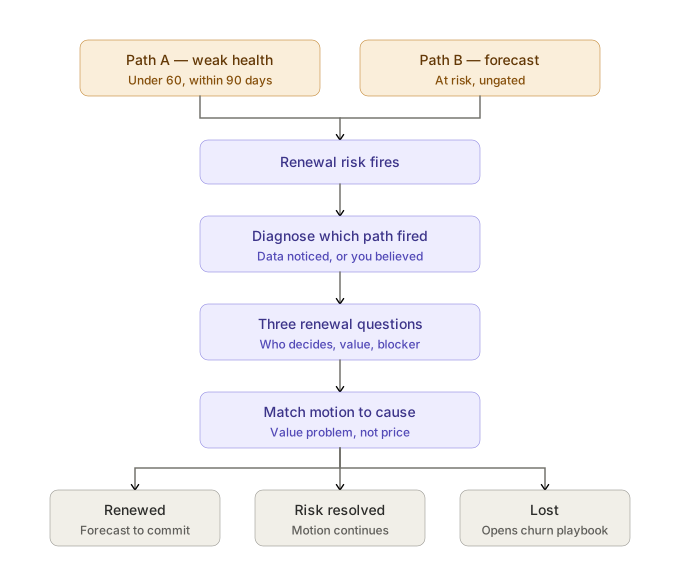
Fires automatically when either condition is true (lib/health/triggers.ts):
A — Weak health inside the renewal window. Composite health is below Stable (Watch List, At Risk, or Critical — i.e. under 60) and the account is 0–90 days from its renewal date, inclusive.
B — Forecast category is "At Risk." On its own. Regardless of health score, regardless of renewal timing.
Why the trigger is built this way
Path B is deliberately ungated, and that's the most important design decision on this page. The CSM's forecast judgment fires the playbook by itself, without waiting for the health model to agree or for the renewal window to open.
The reasoning: forecast folds in things the data model cannot see (2.6 Renewal Forecasting) — a competitive evaluation mentioned on a call, a budget freeze, a champion who's lost an internal argument. If a CSM has looked at an account and concluded the renewal is threatened, requiring the health score to corroborate before the system responds would be backwards. The model computes; the human can override. Same principle as escalation forcing Risk Level to Critical (2.7 Escalation Management).
Path A requires both weak health and proximity because health below 60 on its own is already Health Decline's job (3.1 Health Decline). What makes it a renewal problem is the deadline — limited time to recover, and a contract decision arriving regardless.
Known limits, stated honestly:
- Path B can fire 300 days from renewal, where a renewal-focused procedure is premature. Not wrong — an At Risk forecast means something needs working — but the CSM should expect the early steps to matter more than the renewal-specific ones.
- The window requires
daysToRenewal >= 0, so an account past its renewal date without signature no longer fires this. That's covered by exception handling (2.11 Exception Handling) and the grace-period policy instead. - When Will Not Renew is added as a fifth forecast category (2.6 Renewal Forecasting), it should route to 3.8 Churn & Offboarding, not here — Renewal Risk is for renewals still in play. (v2 item.)
Objective
Identify what threatens the renewal and resolve it, or establish clearly that it can't be resolved — early enough to act either way.
Owner
CSM. Sales joins for pricing and contract terms; Director of CS for Enterprise saves and commercial exceptions (2.5 Cross-Functional Interfaces).
Entry criteria
- Trigger condition met, and
- No Renewal Risk playbook already active (dedupe, 3.0 Playbook Index), and
- Outside the 30-day cooldown
Procedure
1. Establish which path fired
Health-driven and forecast-driven risk start from opposite places:
- Path A (health): the data noticed something. You may not yet know what the customer thinks. Start with diagnosis — run step 1 of Health Decline (3.1 Health Decline) to identify the driving category.
- Path B (forecast): you already believe something. Start by re-reading your own forecast reasoning — 2.6 Renewal Forecasting requires a stated reason — and testing whether it still holds.
2. Answer the three renewal questions
Before any customer conversation, be able to answer:
- Who decides? Named economic buyer. If there isn't one, that's the first problem — an Enterprise renewal with no identified budget holder cannot be forecast Commit (2.11 Exception Handling).
- What's the value case? Concrete evidence of what Prism has delivered. If the value record is empty, that's the second problem (see step 3).
- What's actually in the way? Named blocker, not a general sense of unease.
3. Rebuild the value case if it's thin
The most common failure this playbook encounters is not a hostile customer — it's an invisible value problem (1.5 Customer Journey Map, stage 5). The product worked, nobody counted, and now the buyer is being asked to re-commit budget with no evidence in front of them.
Assemble what exists: reports delivered, end clients served, milestones reached, hours saved if the customer has ever quantified it, escalations resolved well. Thin evidence is still better than none, and the exercise reveals what to instrument going forward.
4. Match the motion to the cause
| Cause | What actually works |
|---|---|
| Dissatisfaction / unresolved issues | Fix or credibly commit to fixing, first. Value conversations over an open wound don't land (2.11 Exception Handling). |
| Low adoption | This is a value-delivery problem, not a renewal problem. Run 3.3 Low Adoption; the renewal follows adoption. |
| Budget pressure | Scope reduction beats churn (2.11 Exception Handling). Bring Sales in for options. |
| Champion departed | Rebuild the relationship before the commercial conversation. Run 3.4 Champion Departure. |
| Competitive evaluation | Understand what they're being promised. Don't disparage; differentiate on what's demonstrably true. |
| Their business changed | Sometimes the honest answer is that Prism no longer fits. Establish that early rather than late. |
The framing error to avoid: treating renewal risk as a negotiation problem when it's almost always a value problem. Discounting an account that doesn't see value buys twelve months and the same conversation.
5. Have the conversation early
Do not wait for the renewal date to raise it. The renewal motion's checkpoints exist precisely so this conversation happens with time to change the outcome (3.7 Renewal Motion).
Don't lead with the renewal. Lead with the value conversation and the blocker; the renewal is the consequence, not the subject. An opening line about contract dates tells the customer this call is about our quarter, not their outcome.
6. Update forecast and escalate as warranted
Every material development changes the forecast, with a stated reason (2.6 Renewal Forecasting). Direction can go up: a resolved blocker is grounds to move back to Likely.
Templates
Full versions in 4.1 Email Template Library.
Value conversation request (pre-renewal)
Email template
Subject: Where [account] is getting value from Prism — worth 30 minutes?
Hi [name] — before we get to the contract conversation later this quarter, I'd rather spend time on whether this is delivering what you hoped when you started.
I've pulled together what we've seen: [specific evidence]. I'd like to walk through it with you, hear what's not landing, and understand what you need from us next year.
Blocker-specific follow-up
Email template
Subject: [Specific blocker] — where we are
Hi [name] — following up on [blocker]. Here's where things stand: [status]. Here's what happens next: [action, owner, date].
I want this resolved well before we talk about renewal, not alongside it.
Escalation path
Escalate (2.7 Escalation Management) when:
- The account is Enterprise and the renewal is genuinely threatened — the Director joins for executive-to-executive contact (2.5 Cross-Functional Interfaces)
- A commercial exception is needed (non-standard terms, concessions) — Director's authority
- An open escalation exists inside the renewal window — the escalation takes precedence over the renewal conversation (2.11 Exception Handling)
- The economic buyer won't engage despite repeated attempts — a renewal nobody senior will discuss is already in trouble
Exit criteria
Close when one of:
- Renewed — signature or confirmed commitment, forecast moved to Commit
- Risk resolved, renewal still pending — the named blocker is gone, forecast upgraded with reasoning, Renewal Motion (3.7 Renewal Motion) continues as routine work
- Lost — the account will not renew. Close this playbook and open 3.8 Churn & Offboarding, with the root cause captured for the quarterly churn review (2.3 Operating Rhythm, 4.5 Churn Review Template)
What does not count as resolution
- The renewal date passed and nothing happened. Auto-renewal without a conversation is luck, not a save — and the underlying risk is still live for next year.
- "They said they're probably fine." Probably is not a forecast. If the buyer won't say yes, the risk stands.
- A discount closed it. That's a purchase, not a resolution. Record it honestly — an account that renewed only on price is a Renewal Risk candidate again next cycle, and the quarterly review should see the pattern.
- The forecast was quietly upgraded with no change in the facts. Forecast movement requires a stated reason (2.6 Renewal Forecasting).
Related pages
- 1.6 Health Scoring Methodology — bands and the At-Risk state
- 2.5 Cross-Functional Interfaces — Sales and Director involvement
- 2.6 Renewal Forecasting — categories, movement rules, why forecast fires this
- 2.7 Escalation Management — escalation mechanics
- 2.11 Exception Handling — grace periods, no sponsor, escalation precedence
- 3.1 Health Decline · 3.3 Low Adoption · 3.4 Champion Departure — playbooks this frequently stacks with
- 3.7 Renewal Motion — the routine motion this runs alongside
- 3.8 Churn & Offboarding — where a lost renewal goes