Sales → CS Handoff Standard
Prism Customer Success Handbook — Section 2.1
Why this exists
Onboarding cannot start well without defined inputs. A handoff that arrives as "closed-won, here's the contact" guarantees the two most predictable early failures in this product (see 1.5 Customer Journey Map):
- The demo gap — the account bought on a demo built with clean sample data, and nobody recorded what was actually shown or promised. The mismatch surfaces in week 2 and reads as the product underdelivering.
- Buyer ≠ implementer — the practice lead signs, then hands the project to someone who sat in none of the sales conversations and inherited a commitment they didn't make.
Both are preventable at handoff and expensive afterward. This page defines what Sales owes CS, and what CS does when it doesn't arrive.
Who does what after the handoff
The customer implements. We guide. Prism is a product, not a service engagement — their people hold the credentials, know which metrics matter to their clients, and choose the pilot end client. The CSM needs product fluency, not engineering skill: able to explain what Connect needs from a customer's database, not to write the query.
| Segment | Implementation | Technical support |
|---|---|---|
| SMB | Fully self-implemented, CSM-guided via templates and docs | Support (break-fix) |
| Mid-Market | Self-implemented, CSM actively guiding | Support; SE by exception |
| Enterprise | Self-implemented, with a Solutions Engineer engaged for warehouse integration, SSO, security review, and custom Portal auth | SE during onboarding; Support ongoing |
The SE is shared with the sales org and engaged part-time — realistic at this company size, where there's no standing implementation team. Whether a deal requires SE involvement is a handoff field, because discovering it at day 20 produces exactly the stall the credentials wall creates.
The handoff checklist
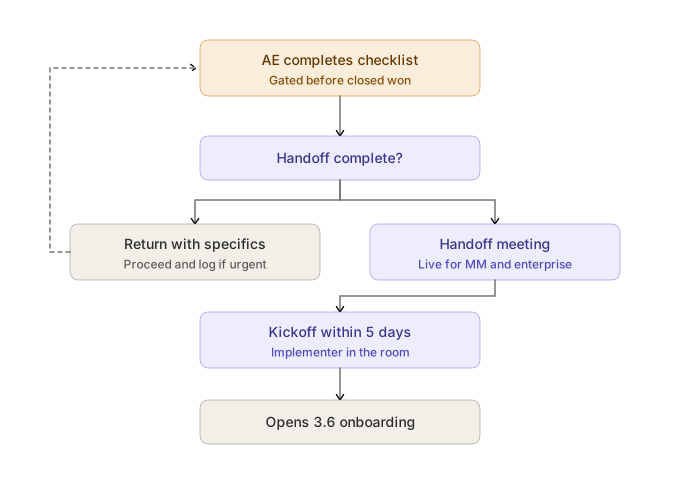
Completed by the AE before the deal is marked closed-won. This is a gate, not a courtesy.
Commercial
- Contract value, term, renewal date
- Products/modules sold, including any Insights attach
- Seats purchased
- Any pricing or contractual commitments made verbally
- Discount justification, if any (relevant later — a heavily discounted account with weak adoption is a different renewal conversation)
What was sold
- Success criteria the customer stated — in their words, not the AE's summary
- What was demoed, specifically: which data sources, which report types, what the sample data looked like
- Commitments and promises made — integrations described as supported, timelines implied, features discussed as coming
- Competitive context: who else they evaluated, why they chose Prism
People
- Practice lead / economic buyer — name, title, role in the decision
- Implementer — who will actually do the work, and whether they were involved in the sales process
- Technical/data owner — who holds admin access to the systems Prism must connect to, and whether they've been engaged
- Any known stakeholder dynamics: internal skepticism, competing priorities, a prior failed tool
Technical
- Data sources to be connected, named
- Does this require SE involvement? If yes, has it been scoped and has the SE been engaged?
- Known technical constraints: security review required, SSO required, data residency, procurement conditions
- Anything the customer flagged as a concern during evaluation
Risk
- Known risks or open issues at signature
- Anything the AE would want to warn the CSM about but wouldn't put in writing casually — this field exists precisely so it does get written down
The handoff meeting
| Segment | Format |
|---|---|
| SMB | Async — CSM reviews the completed checklist; questions raised in writing |
| Mid-Market | Live handoff meeting: AE + CSM |
| Enterprise | Live handoff meeting: AE + SE + CSM |
Live meetings are 30 minutes and cover only what the document can't: tone, dynamics, and the AE's read on the account. The document carries the facts.
When a handoff is incomplete
The CSM can send a handoff back. This is explicit standing, not a personality trait.
- Return it with specifics. Name the missing fields. Don't accept a handoff and chase the gaps later — the gaps are the whole point of the standard.
- If it's blocking, escalate to the sales manager, not to the AE repeatedly. One follow-up to the AE, then escalate.
- If the customer is already waiting, start the kickoff and keep the handoff open. Never delay the customer to win an internal process argument — but log it, because a pattern of incomplete handoffs is a real operational finding, not a series of one-offs.
- Log the gap as an activity on the account. If this account struggles later, the record shows why.
The intent isn't bureaucracy. It's that an incomplete handoff has a predictable, documented cost, and that cost should be visible rather than absorbed silently by CS.
What CS owes back to Sales
The interface runs both ways:
- Kickoff confirmation — CS confirms the kickoff happened and flags any material gap between what was sold and what the customer describes wanting. This is how demo-gap issues get back to Sales in time to change future deals.
- Onboarding outcome — whether the account reached Value Realization, and if not, why.
- Expansion signals — routed to Sales per the ownership matrix (2.5 Cross-Functional Interfaces).
- Churn notice — Sales is notified of churn and its reason, always.
The kickoff handoff moment
The single highest-leverage action in this stage: run a kickoff where the success criteria sold are restated out loud, with the implementer in the room.
That half hour closes the demo gap before it opens and puts the implementer on the same footing as the buyer. If the implementer's understanding differs materially from what the checklist records, that's discovered on day one rather than in week three.
Kickoff agenda detail lives in 2.2 Meeting Standards & Working Norms; the onboarding sequence it starts lives in 3.6 New Customer Onboarding.
Related pages
- 1.4 Customer Lifecycle — Sales Handoff as the first lifecycle stage
- 1.5 Customer Journey Map — the demo gap and buyer≠implementer friction this prevents
- 1.7 Success Plans — where stated success criteria become tracked objectives (MM/Enterprise)
- 2.2 Meeting Standards & Working Norms — kickoff format
- 2.5 Cross-Functional Interfaces — the full CS↔Sales interface and ownership matrix
- 3.6 New Customer Onboarding — the playbook this hands into