Champion Departure
Prism Customer Success Handbook — Section 3.4 · Type: Risk
Trigger
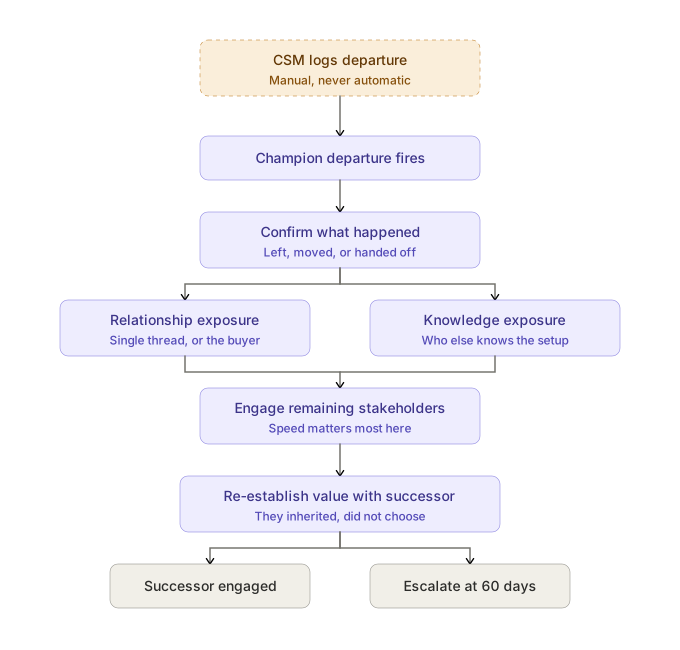
Manual. CSM-initiated. The CSM logs the departure through a purpose-built action that captures a short note (who left, any context), writes an activity record, and creates the playbook with its tasks.
This is the only Risk playbook that is never automatically generated, and that's a deliberate design decision rather than a gap.
Why it can't be automatic
Prism has no way to detect that a champion left. There's no HR feed, no org-chart integration, no notification when someone changes jobs. The signals that would eventually reveal it are all lagging and ambiguous:
- A bounced email tells you weeks later, if you happen to email them
- An unresponsive contact is indistinguishable from a busy one for a month or more
- A drop in Stakeholder Engagement is real but slow — by the time contact recency degrades enough to move the score, the vacuum has already set in
Meanwhile, the fastest and most reliable detection is a human hearing "actually, I'm moving on in a few weeks" on a routine call. Building an automatic trigger on lagging proxies would produce a worse signal than the CSM already has, and would fire late in exactly the situation where speed matters most.
The honest cost of this decision
Detection depends on CSM attentiveness. An account that goes quiet after a champion leaves — and where the CSM doesn't notice or ask — gets caught weeks or months later by Health Decline or Low Adoption, when the damage is done. Two things mitigate this, and both are process rather than tooling:
- Multi-threading (1.6 Health Scoring Methodology). If we have live relationships with more than one person, someone tells us. Single-threaded accounts are the ones where departures go unnoticed, which is a second reason multi-threading is scored.
- Asking directly. Cadence calls should include a question about team or role changes (2.2 Meeting Standards & Working Norms). "Has anything changed on your side?" surfaces departures that nobody would think to announce to a vendor.
This is a case where the handbook compensates for what the software can't see — which is normal, and worth being able to say plainly.
Objective
Re-establish a working relationship and preserve operational continuity before the account drifts.
Owner
CSM. Director of CS joins where the departed champion was also the economic buyer at an Enterprise account (2.5 Cross-Functional Interfaces).
Entry criteria
- A champion, executive sponsor, or key stakeholder has left, changed roles, or handed off the relationship, and
- No Champion Departure playbook already active on the account (dedupe, 3.0 Playbook Index)
Procedure
1. Confirm what actually happened
"Champion departure" covers three materially different situations:
| What happened | What it means |
|---|---|
| Left the company | Full loss. No influence, no continuity, and possibly a competitor hire if they liked us. |
| Changed roles internally | Often recoverable and sometimes an opportunity — a champion who moves up may become a better sponsor, or may seed Prism in a new team. |
| Handed off the relationship | They're still there but no longer own it. The relationship transfers; the advocacy may not. |
The response differs enough that guessing is expensive. Confirm before acting.
2. Assess exposure on two dimensions
Champion loss is usually treated as a relationship problem. For this product it is two problems, and the second is routinely missed:
Relationship exposure
- Were they our only live thread? (Multi-threading, 1.6 Health Scoring Methodology)
- Were they the economic buyer, or did they influence the budget holder?
- Were they an advocate — a reference, a case study participant? If so, that commitment leaves with them (2.10 Advocacy Program).
Operational knowledge exposure
- Did they build the dashboards and configure the integrations?
- Does anyone else at the account know how it's wired?
- If a data source breaks next month, is there a person who can fix it?
An account can be structurally stranded even when sentiment is fine (1.5 Customer Journey Map, stage 5). Usage looks healthy right up until something breaks and nobody knows what to do — and then it churns for reasons that look like product failure.
3. Move fast — speed matters more here than in any other playbook
There is a short window while the departing champion is still reachable and willing to make an introduction. A warm handoff from them is worth more than any amount of cold outreach afterward, and it closes within days or weeks.
If they've already gone, go to remaining stakeholders immediately. The vacuum is what kills accounts — a month of nobody owning the relationship on their side is a month of Prism becoming a line item nobody defends.
4. Identify and engage the successor
The successor inherits a tool they didn't choose. This is the central insight of the playbook and it changes what the conversation has to be.
They have no history with us, no attachment to the decision, and often an incentive to make their own mark — which sometimes means evaluating alternatives. Treating this as relationship-building alone underrates the problem. What's needed is re-establishing the value case from scratch, with someone who wasn't in any of the conversations that justified the purchase.
That means:
- Explaining what Prism does for them specifically, not a product overview
- Showing evidence: what's been delivered, which of their clients are served, what it replaced
- Asking what they need — their objectives may differ from their predecessor's, and the success plan may need rewriting (1.7 Success Plans)
5. Refresh the stakeholder map
Update contacts, roles, and champion designation in the CSP. Then ask the question the map exists to answer: are we single-threaded again? If the successor is now our only relationship, the account is one departure away from the same problem.
Deliberately widen the thread — get introduced to the practice lead, an AM who uses it daily, whoever else touches it.
6. Address the knowledge gap
If the departed champion held the operational knowledge, this is where a training session earns its place (2.9 Customer Education & Enablement). Get a second person trained on the setup. This is retention work, not enablement — the goal is that the account survives the next departure.
7. Update forecast
Forecast cannot be Commit without a named relationship, however healthy usage looks (2.11 Exception Handling). Update with a stated reason (2.6 Renewal Forecasting).
Templates
Full versions in 4.1 Email Template Library.
To the departing champion (while still reachable)
Email template
Subject: Before you go — who should I be working with?
Hi [name] — sorry to hear you're moving on, and congratulations on the next thing.
Before you hand things over: who's picking up [what they owned]? If you're able to introduce us, I'd rather come in with your context than start cold. Happy to make it a five-minute email.
To the successor
Email template
Subject: Introduction — supporting [account] on Prism
Hi [name] — I understand you've picked up [area] from [departed champion]. I'm the CSM for your account.
Rather than send you a product overview, it'd be more useful to show you what's actually running: [specific evidence — dashboards live, clients served, reports going out]. And I'd like to hear what you're trying to achieve, which may be different from what was set up before.
Would 30 minutes in the next week or two work?
Note what the successor email does not do: assume enthusiasm, reference a relationship that doesn't exist, or lead with features. It leads with what's already running for them and asks what they want.
Escalation path
Escalate (2.7 Escalation Management) when:
- No successor identified after 60 days — the account moves to At-Risk regardless of usage or health score (2.11 Exception Handling)
- The departed champion was the economic buyer at a Mid-Market or Enterprise account
- The account is inside the renewal window — a renewal with no named relationship is a P2 at minimum (2.4 Account Prioritization Framework)
- Stacked with Low Adoption or Health Decline — Risk Level is Compounding (1.6 Health Scoring Methodology), and post-departure decline is often steep
Exit criteria
Close when all of:
- A successor or replacement relationship is identified and engaged — an actual conversation has happened, not a name in a field
- The value case has been re-established with that person
- The stakeholder map is current, and the account is not single-threaded on the new contact alone
- Operational continuity is addressed — someone at the account knows how the setup works
What does not count as resolution
- A successor was named but never spoken to. A name in the CRM is not a relationship.
- Usage is still fine. The most dangerous false comfort in this playbook. Scheduled reports keep sending long after the relationship has evaporated; the failure surfaces at renewal, when the decision reaches someone who has never heard of us.
- The successor was friendly on one call. Pleasant is not committed. The test is whether they can articulate what Prism does for them.
- We're still single-threaded. If the whole relationship now rests on one new person, the exposure is unchanged — only the name is different.
Related pages
- 1.5 Customer Journey Map — knowledge concentration in the steady state
- 1.6 Health Scoring Methodology — multi-threading and champion status in Stakeholder Engagement
- 1.7 Success Plans — rewriting objectives with a new stakeholder
- 2.2 Meeting Standards & Working Norms — asking about org changes on cadence calls
- 2.9 Customer Education & Enablement — training a second person as retention work
- 2.10 Advocacy Program — advocacy commitments lost with a departing champion
- 2.11 Exception Handling — the 60-day threshold and the forecast constraint
- 3.0 Playbook Index — why this playbook is manually instantiated
- 3.2 Renewal Risk · 3.3 Low Adoption — playbooks this commonly precedes or stacks with