Customer Journey Map
Prism Customer Success Handbook — Section 1.5
What this page is for
1.4 Customer Lifecycle is our view of the relationship — what stage an account is in, what state it's in, what processes are running. This page is the account's view: at each stage, what are their people actually trying to do, who's involved on their side, where does it hurt, and what do we owe them.
The point isn't empathy for its own sake. Most stalls that look like disengagement are actually structural friction the account can't easily explain to us. A CSM who knows the friction points can diagnose a stall in one question instead of three weeks of unanswered check-ins.
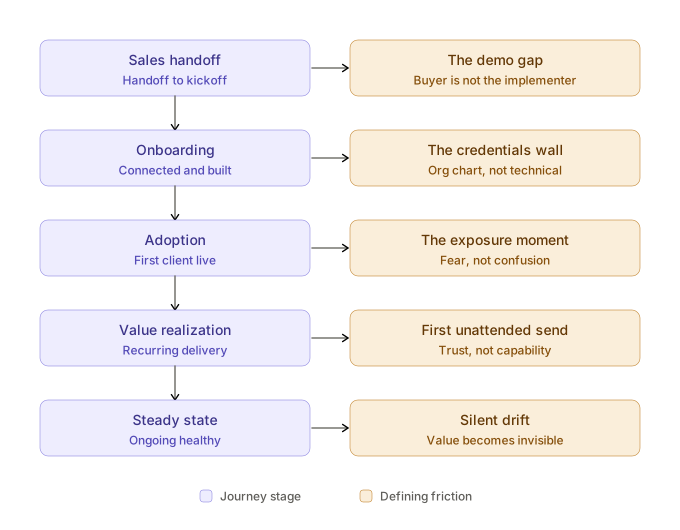
Who's on their side
| Persona | Who they are | What they care about |
|---|---|---|
| Practice lead | The buyer. Owner/Partner, Director of Client Services, Head of Ops — title varies by industry. | Time saved across the team, brand consistency, client retention. Signs the renewal. |
| Account managers | The daily users. Client-facing staff who build and send the reports. | Not having a fourth thing on their plate. Looking good in front of their clients. |
| IT / data | Enterprise (and some Mid-Market) only. Owns the systems Prism connects to. | Security, access control, not being asked for favors by people outside their reporting line. |
One journey, but each stage below names who is central and what the others are doing.
Stage 1 — Sales Handoff
Central persona: practice lead → handing to whoever will implement
What they're trying to do: get started on something they've already been sold on.
Friction
The demo gap. They bought on a demo built with clean sample data. Their real data is messier — inconsistent client naming, internal shorthand field names, gaps. Nobody warned them. The gap doesn't surface at kickoff; it surfaces in week 2, and it feels like the product underdelivering rather than a data problem.
The buyer isn't the implementer. The practice lead signs, then hands the project to an ops person or senior AM who sat in none of the sales conversations. That person inherits a commitment they didn't make and doesn't know what was promised.
What the CSM does
- Run a kickoff that restates the success criteria sold, out loud, with the implementer in the room. This is the single highest-leverage half hour in the relationship — it closes the expectation gap before it opens.
- Ask directly in kickoff: "what does your client data look like today — one system or several, and is client naming consistent across them?" Surfaces the demo gap on day one instead of week two.
- Confirm the implementer by name and confirm they have time allocated. If they don't, escalate to the practice lead now, not at day 30.
Stage 2 — Onboarding (Connected → Built)
Central persona: the implementer (ops or senior AM), with IT involvement
What they're trying to do: connect a data source and get one dashboard built.
Friction
The credentials wall. Connecting a data source needs someone with database or CRM admin access. At most firms that person doesn't report to the practice lead and has no stake in this project. This is the most common early stall — and it's an org-chart problem wearing a technical costume. From the outside it looks like "the customer went quiet."
Data hygiene they didn't budget for. Their data is structured for internal use, not client presentation. Field names are internal shorthand, the same client is named three ways across three systems. Building the first client-ready dashboard forces cleanup work nobody scoped.
Prism is their fourth priority. The AM assigned to build it still has a full client load. This work happens in gaps, not in blocks.
What the CSM does
- Front-load the credentials ask before kickoff, not after. Name the access needed in the pre-kickoff email so the right person can be pulled in early. Treat "who owns admin access to that system" as a kickoff question, not a support ticket later.
- Provide templates that reduce first-build effort to configuration rather than construction.
- Set a realistic sequence with the practice lead that assumes part-time effort. A plan built on the assumption of dedicated time will slip and then feel like failure.
- If the account goes quiet in this stage, ask about credentials before asking about interest. The stall is usually structural.
Stage 3 — Adoption (→ Live)
Central persona: practice lead and account managers together
What they're trying to do: put a dashboard in front of a real end client for the first time.
Friction
The exposure moment. Going live means the firm's work becomes visible to their client in a new way. If the numbers are unflattering, or the data's wrong, that's a client conversation nobody wants to have. This hesitation is entirely rational — and from our side it reads as slow adoption or low engagement.
Nobody wants to be first. Choosing a pilot end client means picking one whose relationship can absorb a rough edge. That's a genuinely uncomfortable choice, and it's easy to defer indefinitely.
Branding by committee. The portal is customer-facing, so marketing suddenly has opinions. Rollouts stall on logo approval and color palettes.
What the CSM does
- Help them choose the pilot. Recommend an end client with a strong, forgiving relationship and reasonably clean data — not their largest or most demanding account. Making this choice for them (as a recommendation they can accept) removes the hardest decision in the stage.
- Provide a "what to say to your client" script for introducing the portal, so the AM isn't improvising a change-management conversation.
- Ask early whether marketing needs to approve branding, and get that started in parallel rather than discovering it as a blocker.
- Treat a stall here as fear, not indifference. The diagnostic question is "what would make you comfortable putting this in front of a client?" — not "are you still interested?"
Stage 4 — Value Realization (→ Recurring)
Central persona: account managers, with the practice lead re-entering
What they're trying to do: let reports go out automatically, on a schedule, without watching them.
Friction
The first unattended send. This is the highest-anxiety moment in the relationship. Something goes to their client, under their brand, without a human checking it first. Many firms cope by manually reviewing every send — which preserves the anxiety and eliminates the time savings that justified the purchase.
Value is real but invisible to the buyer. The AMs feel the hours saved. The practice lead who signed the contract may never open a single report. The person who renews has the least direct evidence.
What the CSM does
- Offer a confidence path, not a switch: manual review for the first cycle, spot-check the second, unattended by the third. Naming the path makes automation feel like a plan rather than a leap.
- Verify the second consecutive send, not just the first. Milestone 4 is defined as two consecutive cycles precisely because one successful send proves nothing about durability.
- Start a value record now, not at renewal. Capture hours saved, reports delivered, client feedback — while the AMs still remember what the old process cost.
- Get the practice lead onto the portal at least once. A buyer who has never seen the product they bought is a renewal risk regardless of how well it's working.
Stage 5 — Steady state (Healthy)
Central persona: account managers day-to-day; practice lead at renewal
What they're trying to do: keep it running, and not think about it.
Friction
Silent drift. A source system changes a field, a report quietly breaks or starts showing wrong numbers, and nobody notices until an end client asks a question. The failure surfaces at the worst possible moment — in front of their client.
Knowledge concentration. The AM who built everything leaves. Nobody else knows how the dashboards are wired. Champion departure here is an operational problem as much as a relationship one — the account can be structurally stranded even if sentiment is fine.
Value becomes invisible because it works. At renewal, nobody has been counting hours saved for eleven months. The product's success is what makes it hard to justify.
What the CSM does
- Watch for delivery failures and data-source errors and raise them before the customer notices. Catching a break first is the highest-trust action available in this stage.
- Ask periodically who else knows how this is set up. Push for documented setup and a second trained user — this is concrete Champion Departure prevention, not just relationship-building.
- Maintain the value record continuously so renewal is a review of evidence, not a memory test.
- Use EBRs (Mid-Market and Enterprise) to put value in front of the practice lead on a cadence, since they won't encounter it on their own.
How this maps to the rest of the handbook
| Journey friction | Where it's handled |
|---|---|
| Demo gap, buyer≠implementer | 2.1 Sales → CS Handoff Standard |
| Credentials wall, data hygiene | 3.6 New Customer Onboarding |
| Exposure moment, pilot selection | 3.6 New Customer Onboarding; 3.3 Low Adoption |
| First unattended send | 3.6 New Customer Onboarding |
| Invisible value to buyer | 4.3 EBR Kit; 3.7 Renewal Motion |
| Silent drift | 2.7 Escalation Management |
| Knowledge concentration | 3.4 Champion Departure |
Related pages
- 1.4 Customer Lifecycle — the stages this journey runs alongside
- 1.7 Success Plans — the milestones each stage drives toward
- 3.6 New Customer Onboarding — the playbook implementing stages 1–4